
By: Darryl Jacobs, ESPN, CBS Sports, NBA TV Networks
When you’ve been around college basketball, as I have as a coach, broadcaster, and analyst, you stop judging players by rankings or reputation alone. You learn quickly that NBA talent reveals itself in layers. Some players show it early. Some grow into it. And some only separate themselves when the game speeds up, and everything is on the line.
Over the years, I’ve also been in the room with NBA personnel and have been called in more than a few times to provide insight and player breakdowns. Those conversations sharpen your eye. At that level, it’s not about hype; it’s about translation. What actually works when the game gets physical, detailed, and unforgiving.
The 2026 NBA Draft class is starting to show a strong group of players who fit that conversation.
At the top of that list are AJ Dybantsa, Darryn Peterson, Cameron Boozer, Caleb Wilson, Nate Ament, and Detroit’s own Darius Acuff Jr. Different paths, different backgrounds, different styles, but they all point toward the same modern reality: basketball has become positionless, and skill now has to travel across roles, not stay in one lane.
That’s the first thing that stands out about this class. You’re not just evaluating “guards” or “forwards” anymore. You’re evaluating impact. Can a player create? Can they defend in space? Can they think the game when it gets tight? Can they hold up when the scouting report is locked in?
That’s the filter.
AJ Dybantsa is one of those guys you notice immediately. His athletic ability is obvious, but what sets him apart is how naturally he pressures a defense without forcing anything. He plays downhill, finishes plays, and doesn’t need a perfect setup to make something happen. Players like him force defenses to load up before the possession even starts.
Darryn Peterson has more control than chaos. He plays at his own pace, and that matters. In today’s game, speed is mistaken for effectiveness. Peterson doesn’t fall into that trap. He dictates the rhythm, gets to where he wants on the floor, and can score without disrupting a team’s flow. That kind of guard is usually trusted when games tighten up.
Cameron Boozer is steady in a different way. No wasted movement. No empty possessions. He produces. Rebounding, positioning, decision-making, and physical consistency play a major role in a mature brand of basketball that coaches and front offices don’t have to guess about. You know what you’re getting, and more importantly, you know it fits winning.
Caleb Wilson is very much a modern forward. Long, mobile, and able to do multiple things without needing constant touches. What I like about players like him is that they don’t require the offense to be built around them to be effective. They can defend multiple spots, run the floor, and still hurt you offensively without dominating the ball.
Nate Ament is a player I saw firsthand at the John Wall Holiday Invitational in Raleigh. That setting tells you a lot. You’re not watching workouts, you’re watching competition. In that environment, what stood out was how comfortable he looked under high-level pressure. His combination of size, skill, and mobility is exactly where the game is headed. He doesn’t look like a traditional position; he looks like a matchup problem waiting to happen.
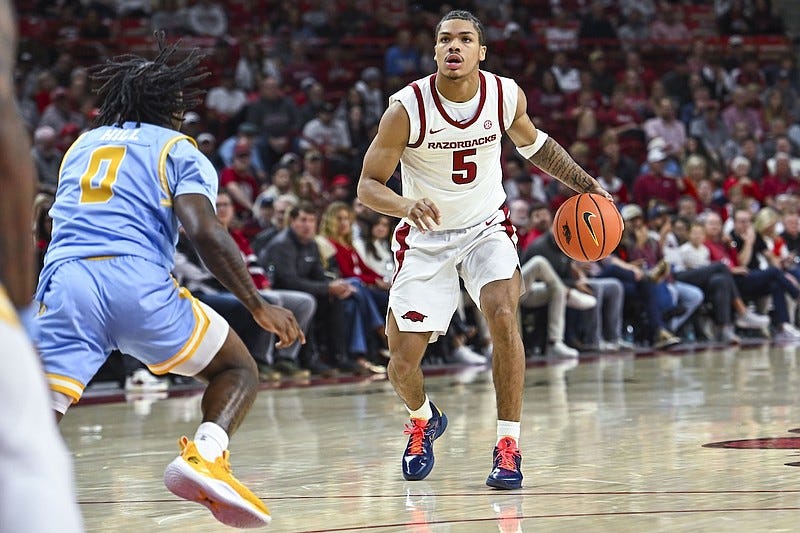
Then there’s Darius Acuff Jr. out of Detroit.
I saw him in the summer before his first year at Arkansas, and even then, there was a poise to his game you don’t always see that early. He plays with pace, doesn’t get rattled easily, and already understands how to manage possessions rather than just attacking. For young guards, that’s a separator. Talent gets you noticed. Control keeps you on the floor.
From there, the conversation naturally shifts to Michigan basketball, where there’s also a growing NBA presence within the program.
Aday Mara, Yaxel Lendeborg, and Morez Johnson Jr. each bring different pieces to the table, but together they represent a roster built with professional upside in mind.
Mara is unique because of its size and feel. Big guys who can see the floor and make decisions from the interior are still valuable in today’s NBA, especially when they don’t slow the game down. He has the passing and interior awareness that can change how an offense flows.
Lendeborg embodies versatility in its simplest form. He can rebound, defend, initiate, and play within structure without needing everything run through him. Those players don’t always get the headlines, but NBA teams value them for their ability to stabilize games.
Morez Johnson Jr. brings toughness and energy. He’s physical, competes, and sets the tone on the glass and defensively. Every good team needs players who impact possessions without needing plays called for them. He fits that mold.
As the season progresses, all of this will shift. It always does. Players rise, roles change, and scouting reports are rewritten. That’s the nature of the process. But what doesn’t change is what NBA teams are really looking for: players who impact winning.
And this 2026 class is starting to show plenty of those.
From the headliners drawing national attention to the younger players still shaping their identities, this group reflects where the game is headed, not where it’s been. And from everything I’ve seen over the years, both in gyms and in front offices, that’s usually the kind of class people talk about for a long time.
ABOUT THE AUTHOR:
Darryl Jacobs, a nationally recognized sports journalist and basketball analyst for ESPN, CBS Sports, and NBA TV, brings more than 20 years of leadership experience across higher education, collegiate athletics, and professional sports. He holds an Honorary Doctorate in Humane Letters. Dr. Jacobs has collaborated with professional athletes and served on national boards focused on collegiate athletics, education, USA Olympic sports, and community development.