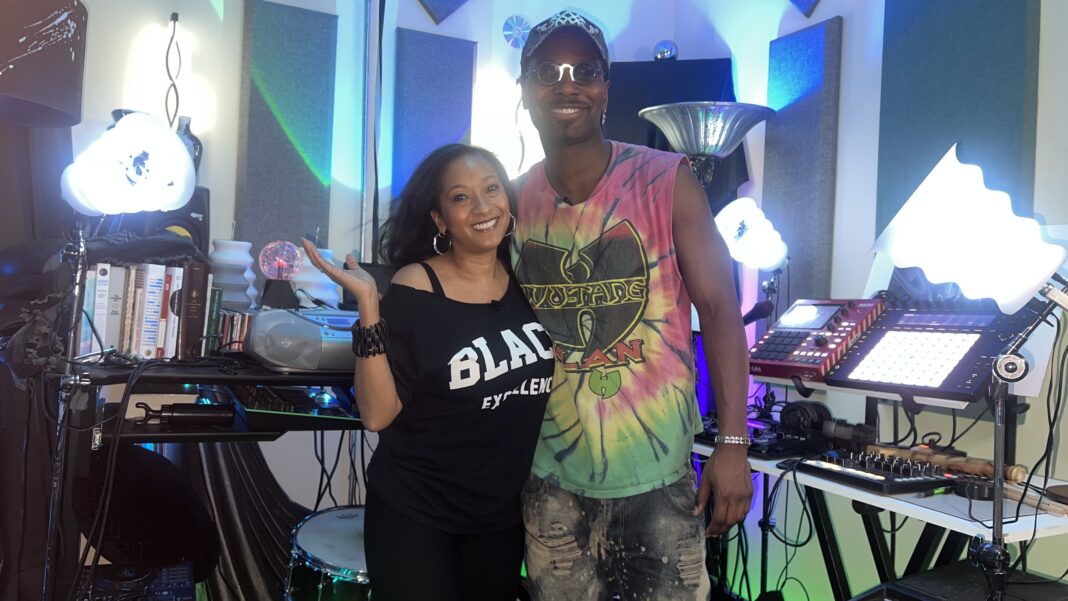

There is something about walking into a studio where the future is already humming.
This month to celebrate Black Histor, I stepped into the creative lab of a young inventor in his early twenties who calls himself Nova Zaii. Not a stage name. Not a nickname. A nomenclature he spent eight years crafting. He describes it as a frequency alignment, a name that matches the vibration of his soul.
That level of intention tells you everything you need to know.
His journey began in a place that is familiar to me, Whitney M. Young High School, the same institution that shaped my own formative years and counts Michelle Obama among its distinguished alumni. There is a particular pride that connects every class that walks those halls. A quiet expectation of excellence. Nova carries that lineage forward in a way that feels both modern and ancestral.
But what he has built is anything but traditional.
Nova is the creator of something he calls Nova Portals. The name barely captures the experience. These are instruments activated by distance sensors. They are played without touch. Yes, without touch.
Sound is extracted from air.
As a musician and inventor, Nova has reimagined technology that dates back more than a century. In 1920, Russian inventor Leon Theremin introduced the world to the theremin, an instrument controlled by manipulating electromagnetic fields with two antennas. It was revolutionary for its time, part of what many refer to as an invisible music lineage.
Nova Portals sit within that lineage, yet they are undeniably contemporary. Where the theremin felt like science fiction emerging from a laboratory, Nova’s creation feels like performance art merging with quantum theory.
Watching him play is an experience in itself. His body becomes choreography. Hands glide through space, shoulders tilt, fingers hover. He is not pressing keys or plucking strings. He is sculpting frequency. The movement is intimate, almost spiritual. It feels less like playing an instrument and more like entering a dialogue with an unseen dimension.
He speaks of being inspired by Miles Davis, particularly the era when Davis bridged traditional jazz with psychedelic rock, experimenting boldly with sound effects and new textures. There is also a clear thread that leads to Jimi Hendrix, whose relationship with his guitar transcended mechanics and became communion. Nova studies that kind of oneness. He is not interested in surface level performance. He is interested in merging with the instrument.
His curiosity does not stop at music. Quantum physics, design, dance, engineering. All of it converges in his work. What began as a school assignment in a performance arts technology program evolved into a prototype. That prototype became a portal. And that portal became a platform.
In our full length interview, you can witness the intuitive connection between Nova and his creation. There are moments when the room feels charged. Not loud, but alive. As if the air itself has texture.
His vision stretches beyond the stage. Nova imagines Nova Portals integrated into homes as immersive wellness tools. He speaks about sound baths, about self care spaces, about teaching young people to use invisible instruments to access visible confidence. He is already performing in a band powered by the portals and is currently working on his first album built around them. Behind the scenes, he and a team of engineers from all over the world are refining the technology, expanding what these devices can do.
There is something powerful about watching a young Black inventor honor a century old innovation while simultaneously rewriting its future.
In a world obsessed with touch screens and constant contact, Nova Zaii is reminding us that sometimes the most profound connections are the ones we do not physically touch at all.
They are felt.
And if his vision continues to unfold the way it has begun, we may all soon be living with portals of our own.