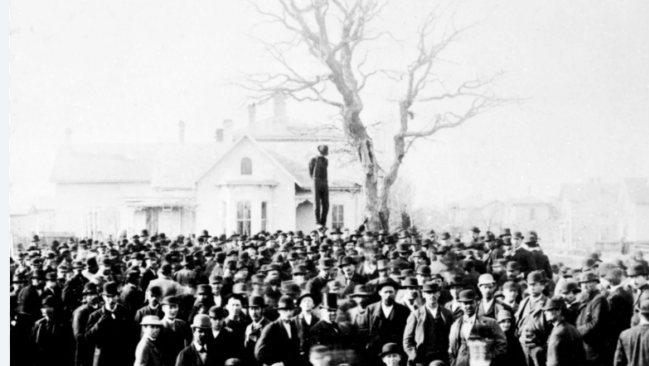

Dead Black Bodies in Trees: Suicides According to Law Enforcement
By Edmond W. Davis
Let me begin with a necessary distinction.
I am advancing a theory—not alleging as fact—that law enforcement involvement, misconduct, negligence, conflicts of interest, or institutional self-protection should never be automatically excluded when African Americans are found hanging from trees.
I am not accusing the officers investigating Cedric Longanga Tayuhe’s death—or officers in any other specific case—of murder, conspiracy, or participation absent evidence.
I am saying something history makes impossible to dismiss: law enforcement itself must remain within the scope of scrutiny.
American lynching history is filled with examples in which public officials failed to protect Black prisoners, tolerated mob violence, ignored perpetrators, or participated in systems that permitted racial terror to occur without meaningful consequences. The Equal Justice Initiative has documented more than 4,000 racial-terror lynchings of Black Americans across 20 states between 1877 and 1950.
That history gives Black America no obligation to automatically treat every law-enforcement institution as a disinterested observer when another Black body is discovered in a tree. This is not a return to some distant “sundown” America.
For many Black Americans, the deeper concern is that some of the institutional habits that enabled America were never completely dismantled.
So from this point forward, my position is simple:
When a Black American is discovered hanging from a tree, investigate the investigators, too.
Examine dispatch records. Examine responding officers. Examine conflicts of interest. Examine surveillance. Examine communications. Examine the chain of custody. Examine who knew what and when.
That is not anti-police.
That is pro-evidence.
A Black man is found hanging from a tree.
Yes, America is experiencing economic and social pressures. Yes, Black Americans experience depression, trauma, and suicide like every other population.
But Black America has also survived slavery, Jim Crow, racial-terror lynching, segregation, mass incarceration, discrimination, police brutality, unemployment, and generations of structural inequality.
Suicide is unquestionably a serious issue in the Black community.
But a tree carries a particular history.
And when that history appears before us again, America should investigate first and explain later—not explain first and investigate afterward.
Before America has absorbed the victim’s name, before independent experts have examined every question, and sometimes before the public has seen complete medical-examiner findings, a familiar word can enter the conversation through authorities:
Suicide.
But what does that word actually mean? Merriam-Webster defines suicide as ending one’s own life voluntarily and intentionally.
Notice those essential concepts:
Voluntarily. Intentionally.
Those are conclusions requiring evidence. They should never be assumptions preceding it. That is precisely why I challenge what I see as an emerging and deeply troubling narrative surrounding some Black people found hanging from trees: suicide can enter the official narrative early, while questioning whether homicide, coercion, staging, or racial violence has been adequately excluded is dismissed as speculation.
My standard is straightforward:
If it is too early to call it a lynching, then it is also too early to call it a suicide.
FROM ANATOMY OF A LYNCHING TO THE ANATOMY OF A “SELF-LYNCHING”?
There is a reason I chose this title. Historian James R. McGovern’s Anatomy of a Lynching: The Killing of Claude Neal examines one of the most notorious racial-terror killings in American history.
Claude Neal was a 23-year-old Black farmworker accused of murdering a white woman in Florida in 1934. Authorities moved Neal between jails in an effort to protect him, but six white men eventually seized him from an Alabama jail, returned him to Jackson County, Florida, tortured and murdered him, and later displayed his mutilated corpse. The Equal Justice Initiative records that Neal’s body was ultimately hung from a tree on the courthouse lawn.
That history matters because Neal had already entered government custody.
The state possessed him. The state had a duty to protect him. Yet a mob reached him anyway.
McGovern’s great contribution was that he examined more than the rope and the tree. He examined the suspect, the community, mob psychology, institutions, justice, local reaction and the national conscience.
That is what an anatomy does. It dissects. Who knew? Who acted? Who failed to act? Who had authority? Who benefited from silence? What happened before the body reached the tree? And what happened afterward?
Nearly a century later, that framework produces an uncomfortable but necessary question:
If historians can anatomize a 1934 lynching, why shouldn’t Americans demand an equally rigorous anatomy of a mysterious hanging in 2026?
WHAT I MEAN BY “SELF-LYNCHING”
I am introducing a deliberately provocative term:
Self-lynching.
“Self-lynching” is not a medical, forensic, or legal classification.
It is my rhetorical term—a paradox designed to expose how extraordinary the imagery is.
Historically, lynching involved someone else inflicting terror and death upon the victim. A “self-lynching,” therefore, describes the modern conclusion sometimes offered when a Black person is said to have voluntarily recreated, alone, perhaps the most recognizable visual symbol of racial terrorism in American history.
Can a Black person die by suicide through hanging?
Absolutely.
That is not disputed.
What I dispute is the idea that the conclusion should outrun the evidence.
If authorities conclude that a Black person discovered suspended from a tree died by suicide, then give the public—and most importantly the family—the anatomy behind that conclusion.
Who owned or purchased the ligature? How was it attached? How did the deceased reach the suspension point? Were there fingerprints or DNA belonging to another person? Were there defensive wounds? What did toxicology establish? What were the lividity and injury patterns? What does cellphone or location data reveal? What do surveillance cameras show? Was there evidence of suicidal intent? Was there a manifesto by the deceased? Were other individuals present? What evidence affirmatively excludes another person’s involvement? Was the scene independently reviewed?
Those are not accusations. Those are forensic questions.
That is anatomy.
CEDRIC TAYUHE DESERVED AN ANATOMY Cedric Longanga Tayuhe was 36 years old. The North Carolina Beat reported that Tayuhe was discovered dead at Harris Depot Park in Harrisburg, North Carolina, on June 6, 2026. The publication reported that the Cabarrus County Sheriff’s Office described the circumstances as consistent with suicide and did not dispute the report that he had been found hanging from a tree.
Those words matter.
Consistent with suicide is not synonymous with every reasonable alternative independently excluded.
Again, I am not accusing the deputies investigating Tayuhe’s death of killing him.
I have seen no evidence establishing that.
I am not declaring Tayuhe a confirmed lynching victim.
I am demanding something far more defensible:
Show us the anatomy.
Show the timeline. Show the autopsy. Show the toxicology. Show the scene reconstruction. Show what established voluntary and intentional self-destruction. Show what excluded another person. And explain whether investigators themselves, their relationships, actions, and handling of evidence were independently reviewed. If the evidence overwhelmingly establishes suicide, then let the evidence speak. If it points elsewhere, follow it there.
HISTORY PUTS LAW ENFORCEMENT UNDER THE MICROSCOPE
Black distrust of American law enforcement did not appear from nowhere.
The racial-terror era was not simply a story about ropes, mobs, and trees. It was also a story about institutions—about who protected Black citizens, who did not, who investigated killings, and who escaped punishment.
Recent historical investigations continue to document government complicity. A Maryland state truth-and-reconciliation investigation, for example, examined dozens of lynchings and described ways law enforcement, political institutions and local media enabled racial violence to proceed with impunity.
That history does not establish the guilt of any officer today. But history does establish the legitimacy of institutional scrutiny. And America has seen what lethal abuses of official authority can look like in our own century.
George Floyd died in 2020 beneath the restraint of Minneapolis police officer Derek Chauvin. Chauvin was convicted of second-degree murder in state court and later pleaded guilty federally to willfully depriving Floyd of his constitutional rights through unreasonable force that resulted in his death. Three other former Minneapolis officers were also convicted on federal civil-rights charges related to their conduct and failure to intervene or provide aid.
Millions watched the video.
I regard Floyd’s killing as carrying some of the public spectacle and terror historically associated with lynching—not because it legally constitutes a historical lynching, but because a Black man’s death at the hands of state authority became a public spectacle witnessed around the world. It was the most publicly viewed death in global history, and it was a 21st-century lynching of a Black man by police.
That comparison is mine.
The underlying homicide and civil-rights violations, however, are matters of judicial record.
So when authorities tell Black America simply to “trust the process,” history answers:
Then show us the process.
THE NUMBERS REQUIRE QUESTIONS, NOT ASSUMPTIONS CDC data complicate simplistic racial assumptions about suicide.
In 2023, the age-adjusted suicide rate among non-Hispanic Black Americans was 9.1 per 100,000, compared with 17.6 for non-Hispanic White Americans and 23.8 for non-Hispanic American Indian/Alaska Native Americans.
Those numbers cannot tell us how Cedric Tayuhe—or any particular person—died.
Nor do overall suicide rates tell us which method an individual might use.
But they reinforce why individual deaths should be investigated scientifically rather than interpreted through assumptions.
The question is not:
Do Black people die by suicide?
Of course they do.
The question is:
How do you know this Black person did?
DON’T NORMALIZE THE TREE
This is where McGovern’s Anatomy of a Lynching becomes more than a history book.
Claude Neal’s death in 1934 and Cedric Tayuhe’s death in 2026 cannot responsibly be declared equivalent.