
New study shows half of state hospitals at risk reducing staff, cutting services, or closing, safety net hospitals most vulnerable
SEIU Healthcare Illinois members demand Illinois leaders keep safety net hospitals open, fully funded, safely staffed, private-equity-free
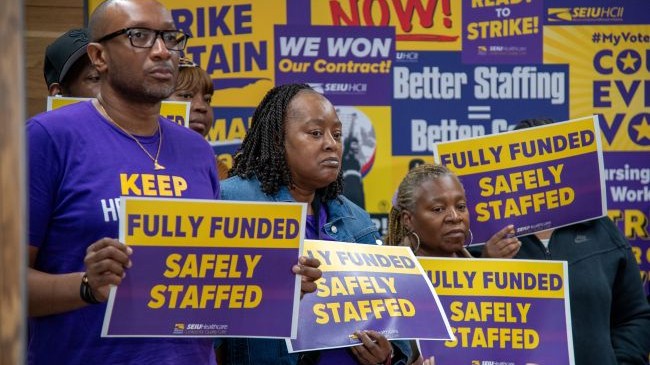
As a new study shows half of Illinois hospitals are at risk of reducing staff, cutting services, or closing, safety net hospital workers and members of SEIU Healthcare Illinois (HCII) joined State Senator Lakesia Collins for a press conference Tuesday to demand state leaders take urgent action to keep safety net hospitals open, fully funded, safely staffed, and to stop private equity firms from running critical healthcare facilities into the ground.
During the press conference, safety net hospital workers described the essential healthcare services they provide to their communities that could be lost without state funding. Cherelle Sullivan, an EVS Worker for Sodexo at Mt. Sinai Hospital and HCII member, described a poignant moment where she cleaned the room of an elderly woman in the ER who had passed away so the family could say goodbye with dignity. “Nobody talks about that when we talk about hospital funding. Nobody puts a dollar figure on that, but somebody has to make that possible,” Sullivan said.
“When you’re deciding how to fund hospitals like mine, I’m asking you to remember that this isn’t abstract,” continued Sullivan. “It’s the woman who cleans the rooms so your family can say goodbye; it’s the workers covering 14 extra days a month just to keep the doors open; it’s my neighbors who rely on this hospital for their health as well as their paycheck.”
“As a crisis worker, I care for the community members on the worst days. I meet them with compassion and give my all to make sure that they get the health care they deserve,” said Rodney Brown, a crisis worker at St. Bernard Hospital and HCII member. “We have a responsibility to fight against the cuts of Medicaid instead of just giving up on our hospitals.”
Safety net hospitals are lifelines for millions of Illinois families, serving patients with some of the greatest health needs, many of whom have few other options for care.
“After years of starving our community safety-net hospitals of the funding they need, our government let a private equity company swoop in, buy two major community hospitals, and run them into the ground,” said State Senator Lakesia Collins. “Without immediate state funding, community hospitals are at risk of cutting life-saving healthcare services or shutting their doors completely. Illinois has the money, but it’s going to the wrong places, like four billion in tax breaks for corporations and huge subsidies for corporate hospitals like Northwestern and wealthy neighborhoods. This is about priorities.”
Private equity is making an already dangerous situation worse. Workers pointed to the collapse of West Suburban Medical Center and Weiss Memorial Hospital under Resilience Healthcare as a warning of what can happen when private equity takes control of safety net hospitals.
After the press conference, workers from St. Bernard Hospital, Roseland Hospital, Mt. Sinai Hospital, and Loretto Hospital took their demands directly to the Illinois Health Facilities and Services Review Board (HFSRB), where they testified about the devastating impact of private equity takeovers, hospital closures, inadequate funding, and staffing shortages for the patients and communities they serve.
The crisis is reaching a breaking point. Without significant state investment, more safety net hospitals could be forced to cut lifesaving services or shut their doors altogether — with closures putting even greater pressure on the hospitals that remain.
“I am scared to know what cuts to funding look like because I know it means cuts to more life-saving services or closing hospital doors completely,” said Deborah Ross, a CNA at Mt. Sinai hospital and HCII member. “We need our state lawmakers to sit down with healthcare workers and do a real, long-term plan to keep Illinois community hospitals open, fully funded and safe.”
When a safety net hospital closes, the consequences spread far beyond a single facility or neighborhood. Patients must travel farther for emergency and routine care, surrounding hospitals absorb more patients, emergency room wait times increase and already-stretched healthcare workers face even greater workloads.
“As lawmakers, we have a responsibility to make sure that community hospitals stay open, so that families can get the care they need,” continued Collins. “The stakes couldn’t be higher… people will die.”
Lawmakers shadow safety net hospitals workers on the job
Tuesday’s press conference comes after months of safety net hospital workers sounding the alarm on the deepening healthcare crisis facing Illinois families. They have been meeting with state lawmakers to make the stakes of the crisis clear: if Illinois allows safety net hospitals to close, people will die.
“After walking through Mount Sinai today and hearing directly from hospital staff about the work that they do every day to care for working Illinoisans, I want to continue urging our Illinois General Assembly to continue supporting legislation that funds and protects our safety net Hospitals,” said State Representative Lillian Jimenez after spending a day at Mt. Sinai Hospital. “Closure will overwhelm surrounding hospitals, creating a ripple effect that threatens the entire Illinois healthcare system.”
“The state has a responsibility to provide safety nets the funding they need to take care of the most vulnerable Illinoisans, and to create clear standards for accountability to make sure that the needs of patients are prioritized,” said State Representative Norma Hernandez.
“Seeing firsthand today the care and commitment of the hospital workers at Mt. Sinai reaffirmed just how important it is that we fight to protect safety net hospitals in our communities,” said Cook County Commissioner Michael Scott Jr. “This is a county issue, a city issue, a state issue, and a federal issue. Every elected official who represents residents who depend on safety net care has a responsibility to stand up in this moment.”
Safety net hospitals in crisis
Safety net hospitals disproportionately serve Medicaid patients and Black and Brown communities that have long faced barriers to quality healthcare and higher rates of chronic illness, maternal mortality and preventable disease. Chicago’s stark health disparities mean where someone lives can dramatically shape how long they live, with data showing a 20-year life expectancy gap between some majority-Black and majority-white neighborhoods.
Unlike large, multibillion-dollar health systems, safety net hospitals have little financial cushion to absorb further funding losses. Public Medicaid funding accounts for more than half of their operating budgets, leaving them especially vulnerable to federal funding cuts.
That financial pressure is set to intensify as hospitals absorb federal Medicaid cuts enacted under President Trump’s “Big Ugly Bill”, which cuts federal Medicaid spending by more than $900 billion nationally over the coming decade. The cuts are expected to leave hundreds of thousands of Illinois residents without health coverage, putting even greater strain on hospitals serving communities that already face significant barriers to care.
Illinois has the resources to prevent the crisis from getting worse, but state leaders have not made safety net hospitals a funding priority. State leaders could have addressed this in the recent state budget, but failed to pass a budget with the funding that safety net hospitals need.