


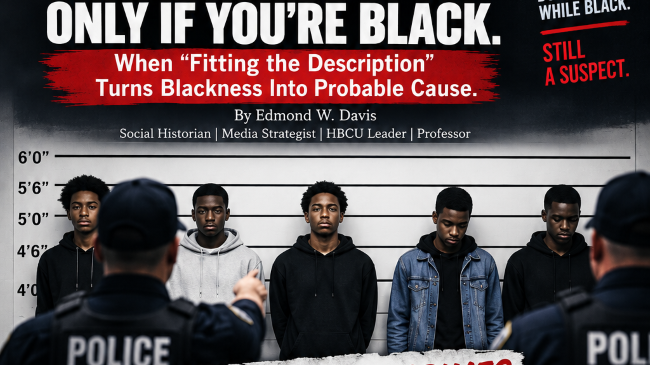

When “Fitting the Description” Turns Blackness Into Probable Cause
By Edmond W. Davis
Tashawn Bernard was 12 years old.
Driving while Black. Working while Black. Walking while Black. And now, apparently, doing chores while Black.
These phrases describe a painful American reality in which routine encounters between Black citizens—particularly Black males—and law enforcement can escalate into suspicion, detention, handcuffs, force, or arrest. Sometimes authorities acknowledge “mistaken identity.” Other cases raise serious questions about racial profiling, inadequate verification, and police misconduct.
Search “mistaken identity police arrest,” and the images and news reports tell their own disturbing story: innocent people handcuffed, detained, jailed, and sometimes traumatized because they supposedly “fit the description.”
How many times can “mistaken identity” happen before America stops treating every incident as merely an innocent mistake? And what does the persistence of these racial disparities tell us about anti-Blackness in American institutions?
On August 10, 2023, Bernard was outside his Lansing, Michigan, home taking out the trash when police detained and handcuffed him while searching for a suspected car thief. Officers had the wrong person. Lansing police acknowledged the misidentification and released Bernard within minutes. But a few minutes can become a lifelong memory when you are a child surrounded by armed adults with the authority to take away your freedom.
In July 2025, Bernard and his family filed a federal civil-rights lawsuit against Lansing and several officers.
There is no comprehensive national database documenting every innocent person stopped, searched, handcuffed, detained, or arrested because police believed that person “fit the description.” That absence matters. America collects extensive criminal-justice statistics, yet we still cannot determine exactly how many innocent citizens experience mistaken-identity police encounters each year.
What we can measure is troubling.
According to the U.S. Bureau of Justice Statistics, Black people in 2022 were three times as likely as white people—6% compared with 2%—to experience threatened or actual nonfatal force during their most recent police-initiated or traffic-accident-related contact.
Bernard was not committing a crime. He was doing what his father asked him to do: taking out the trash.
His family’s lawsuit alleges lasting emotional harm. Therapy may help a traumatized child process such an experience, but therapy cannot erase the moment.
In a well-run organization, when an unacceptable outcome occurs repeatedly, leaders examine the process itself. One of the first questions should be: Was the established process followed? If it was, yet innocent people repeatedly suffer unacceptable outcomes, then perhaps the process itself requires examination.
Wrongful-conviction evidence makes that examination even more urgent. The Innocence Project reports that 58% of the people it has helped free or exonerate through its DNA work are Black and that 62% of its cases involved eyewitness misidentification.
Now technology has added another layer.
WHEN THE COMPUTER “FITS THE DESCRIPTION”
Facial recognition was supposed to make identification more scientific. Instead, when investigators treat an algorithmic lead as evidence rather than a lead requiring rigorous independent verification, old human biases can acquire digital authority.
The National Institute of Standards and Technology (NIST) found significant demographic differences across many facial-recognition algorithms. In one-to-one matching, NIST found higher false-positive rates for African American and Asian faces compared with Caucasian faces, with differences often ranging from 10 to 100 times, depending on the algorithm.
Those errors have real consequences.
Robert Williams, a Black Detroit father, was wrongfully arrested in 2020 after facial-recognition technology incorrectly connected him to a shoplifting investigation. He was detained for nearly 30 hours.
Nijeer Parks was wrongfully arrested in New Jersey following an erroneous facial-recognition result. Michael Oliver was wrongfully arrested in Detroit. Porcha Woodruff, a Black woman who was eight months pregnant, was wrongfully arrested following another faulty facial-recognition investigation.
And this problem has expanded beyond Black defendants. By April 2026, the American Civil Liberties Union identified 14 publicly known people wrongfully arrested in the United States following police reliance on erroneous facial-recognition results.
These are not statistics without faces. They are children, parents, workers, and citizens whose freedom was interrupted because a person—or increasingly, a computer—essentially said:
You look like the person we want.
AMERICA MUST CONFRONT THE HISTORY
Historical accuracy matters here.
Not every American police department descended directly from slave patrols. Northern policing developed through systems of watches, constables, and later professional departments. But historians have extensively documented slave patrols as an important part of the development of law enforcement in the American South.
Slave patrols controlled the movement of enslaved Black people, searched quarters, suppressed gatherings, and captured people attempting to escape bondage. After emancipation came Black Codes, Jim Crow enforcement, and periods when racial terror and official authority overlapped.
Historian Sally Hadden’s scholarship on police and slave patrols also documents how the Ku Klux Klan later drew upon slave-patrol practices to terrorize Black Americans, sometimes with cooperation from local law enforcement.
That history does not mean today’s individual police officer is a slave patroller.
It means American law enforcement inherited a complicated racial history that cannot responsibly be discussed without acknowledging race.
And that history matters when a modern officer hears “Black male” and encounters a Black child taking out the trash.
BLACKNESS CANNOT BE THE DESCRIPTION
“Black male, dark clothing” cannot become a license to detain every Black man or boy within walking distance.
Neither should artificial intelligence become digital racial profiling with a confidence score attached.
Police officers have an extraordinarily difficult responsibility. They sometimes must make decisions rapidly, and suspect descriptions are legitimately necessary to locate dangerous individuals. But precisely because government gives police the extraordinary authority to stop, search, handcuff, detain, and arrest citizens, verification must be rigorous.
Race alone is not probable cause.
A computer-generated candidate is not probable cause.
Being nearby is not guilt.
Looking vaguely similar is not guilt.
Proverbs 18:13 warns against answering a matter before fully hearing it. John 7:24 instructs us not to judge merely by appearances, but to judge rightly. Isaiah 1:17 commands us to “seek justice” and defend the oppressed.
Those principles belong in the courthouse, police academy, patrol car—and increasingly, inside the algorithms government purchases.
The reforms are not mysterious: require independent corroboration before arrests involving facial recognition; prohibit an algorithmic candidate from becoming the sole basis for probable cause; strengthen body-camera accountability; improve eyewitness-identification procedures; audit racial disparities; document mistaken-identity detentions; and establish national reporting so America can finally determine how frequently innocent people are stopped because they supposedly “fit the description.”
Good policing should welcome safeguards that improve accuracy.
Because every wrongful arrest potentially creates two victims: the innocent person whose freedom was violated and the public whose actual suspect may remain free.
Tashawn Bernard was taking out the trash.
He was 12.
He was Black.
And he was innocent.
The phrase “mistaken identity” may describe what happened.
It should never be enough to excuse why it keeps happening.

