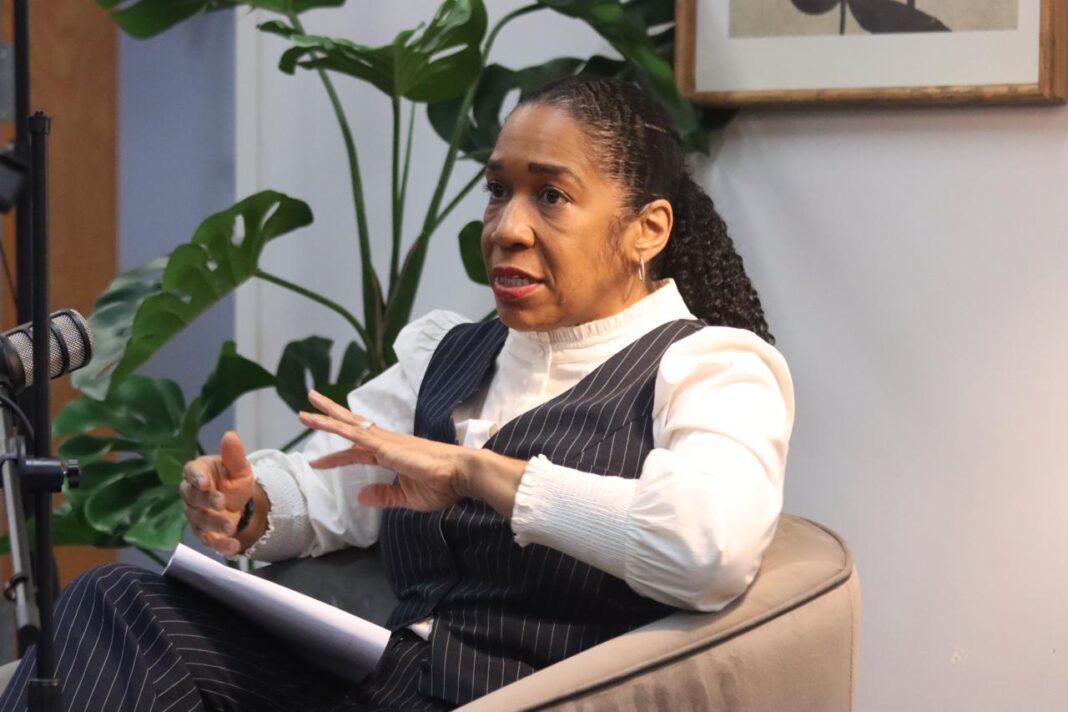

Photo Credits: Isaac Lewis, North Lawndale Community News
The 2026 midterm elections are approaching fast, with just nine months to go before voters head to the polls.
As Illinois prepares for an open U.S. Senate seat following Senator Dick Durbin’s announcement that he will step down, 48th Lieutenant Governor Juliana Stratton, a South Side native, is positioning herself as a candidate grounded in the fight for justice, equity, and opportunity.
Her campaign centers on economic mobility, humanity, access to health care, and a deep commitment to the Black community.
Stratton, who has served as Illinois’ lieutenant governor since 2019, says her campaign is driven by a belief that government must work for everyday people, particularly those whose voices are often missing from national decision-making.
“There aren’t enough voices like mine in Washington,” Stratton has said, highlighting the need for leadership rooted in lived experience and accountability.
During a recent visit to the Chicago News Weekly headquarters on Chicago’s West Side, the discussion was candid and wide-ranging, offering space to answer questions and hear direct feedback.
The conversation focused on accountability, economic justice, health care, and the critical role Black-owned media plays in shaping public discourse.
“Accountability isn’t just something you say, it’s something you show,” she said, committing to maintaining open lines of communication with Black media and community leaders.
Stratton Says Senate Bid Is About “Fighting for the People,” Not Corporate Interests
Lieutenant Governor Juliana Stratton says her decision to run for the United States Senate is rooted in personal experience, a sense of urgency, and a belief that Washington needs new leadership willing to confront what she calls “unprecedented chaos.”
“There aren’t a lot of voices like mine in Washington, D.C., but I believe there should be; this journey really started for me ten years ago.”
That journey, she explained, began when she became the primary caregiver for her mother, Velma, who was diagnosed with Alzheimer’s disease. At the time, Stratton was also raising her own children and working full-time. While caring for her mother, she said she watched lawmakers attempt to roll back health care protections for seniors.
“I saw efforts to strip away health care from people like my mother,” Stratton said. “And I couldn’t sit by and watch that happen.”
Motivated by those policies, Stratton ran for state representative against a 13-year incumbent who supported the changes. She won. Her mother passed away the day before Stratton launched her campaign.
“Caring for my mother was the hardest thing I’ve ever done, but it was also the greatest honor of my life. I feel like she’s been with me every step of the way, reminding me why I do what I do and that government should be a partner to the people, not a roadblock.”
The Road to Listening: Juliana Stratton’s Mission to Give People a Voice
Six months into her first term, Stratton was selected by Governor JB Pritzker to be his running mate. She says their administration offers a blueprint for what she hopes to accomplish in Washington.
“We raised wages, protected reproductive freedom, created thousands of jobs, and lowered the cost of prescription drugs,” Stratton said. “That’s what government can do when it’s focused on people.”
Stratton contrasted that record with what she described as growing instability at the federal level.
“We’re seeing attacks on the Constitution, the rule of law, our communities, and our economy. Health care is being stripped away. Food assistance is under attack. This administration even went to court to stop people from receiving SNAP benefits.”
Her campaign platform, which she calls “Let’s Give the People What They Want,” centers on affordability, access to health care, and protecting democracy.
She also emphasized her refusal to accept corporate PAC money, saying it’s essential to restoring public trust.
“I’m the only candidate in this race not taking corporate PAC money,” she said. “That matters because people are tired of seeing the wealthiest get wealthier while nothing changes for them.”
Stratton said her campaign has gained momentum, citing endorsements from Governor Pritzker, Senator Tammy Duckworth, several members of Illinois’ congressional delegation, EMILY’s List, the Illinois Nurses Association, and Citizens United.
“I not only believe I can win,” she said. “I plan to win.”
With early voting approaching, Stratton said her focus remains on clearly laying out the stakes of the race.
“This moment requires steady leadership, new energy, and someone willing to fight,” she said. “I’m ready to bring that fight to Washington on behalf of the people of Illinois.”
Where Black Media, Business, and Accountability Meet
She also pointed to economic disparities, noting that more than 300,000 Black women were pushed out of the workforce during the first six months of Donald Trump’s presidency.
“This is a crisis,” Stratton said. “And just like I did ten years ago, I’m stepping up because there’s a real need for leadership right now.”
She pointed to her leadership of Illinois’ Restore, Reinvest, and Renew (R3) program as an example of her approach to addressing historic harm.
“It’s not called a reparations program, but it is about repair,” Stratton said. “We’ve put nearly $300 million into communities most harmed by the war on drugs into violence prevention, reentry services, economic development, legal aid, and youth development.”
Stratton said Illinois’ approach demonstrates how government can intentionally reinvest in communities damaged by systemic policy decisions.
“There has been tremendous harm done to Black communities in this country and the legacy of that harm continues.”
She also cited housing policy, redlining, and down-payment assistance as areas where she believes reparative investment is necessary.
“My grandfather helped end redlining in Illinois,” Stratton said. “We still see its effects in segregated housing, appraisals, and home values. That legacy doesn’t disappear on its own.”
The conversation shifted sharply when Black publishers raised concerns about affordability, federal advertising dollars bypassing Black media, and what accountability would look like if Stratton is elected.
Stratton acknowledged the frustration and emphasized that Black media and Black-owned businesses are “under attack,” especially amid rollbacks of DEI initiatives.
“I absolutely see you as business owners,” she said. “And I understand the intersection you’re sitting in, Black media and Black business. This cannot be a monologue; it has to be a dialogue. I will never implement policy without the voices of the black community and stakeholders at the table.”
Commitment to Justice, Equity, and Health Care
Stratton also addressed health care reform, saying she supports Medicare for All and believes the current system prioritizes profit over people.
She shared a personal story about her daughter’s rising Affordable Care Act premiums and warned that access alone is not enough.
“Quality of care matters,” Stratton said. “If you’re in Austin, your life expectancy can be 20 years less than someone in River North. That is unacceptable.”
“When DEI is under attack, fewer Black students become doctors, and that directly affects how seriously Black patients are taken.”
Pointing to Illinois reforms, Stratton said she wants to bring solutions like removing medical debt from credit reports, lowering prescription drug costs, and ending insurance step therapy to the federal level, particularly to tackle disparities affecting Black communities.
Her journey, from attorney and mediator to state legislator and lieutenant governor, reflects a consistent commitment to public service and community-centered leadership.
“Accountability works both ways,” Stratton said. “Our voices shouldn’t just be at the table, they should guide the agenda. Tell me what you need, and I’ll take your voices with me to Washington.”