


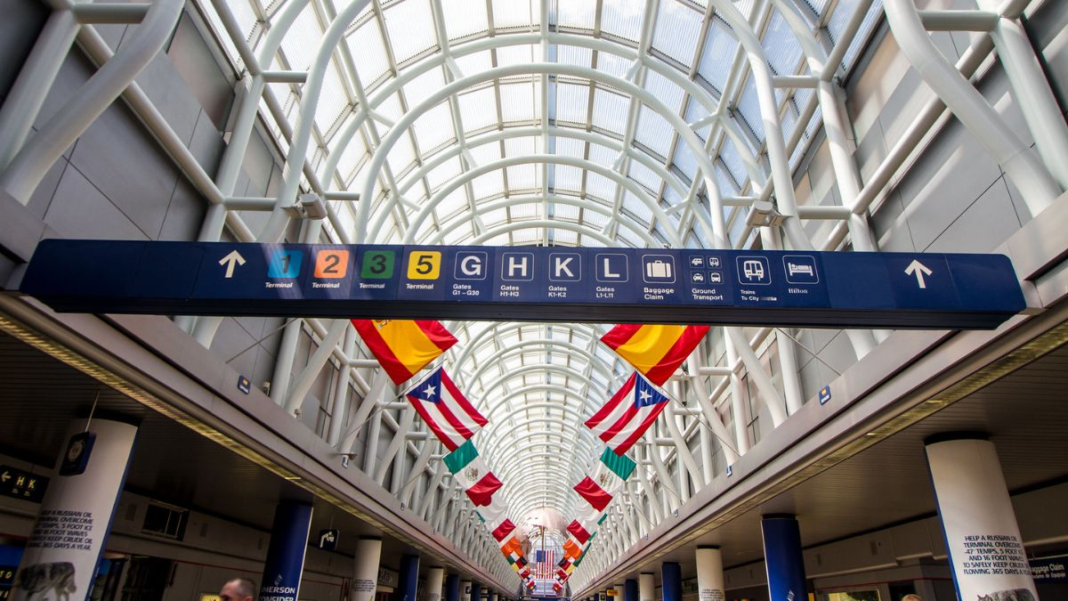

A nationwide breakdown in air traffic control communications continued to disrupt travel through Chicago on Saturday, November 14, with 441 flights canceled at O’Hare and Midway international airports as airlines worked to recover from an unprecedented interruption in flight operations.
O’Hare recorded 385 cancellations by 6:30 a.m., while Midway reported 56, according to Chicago Department of Aviation figures cited by FOX 32 Chicago. Average flight delays at both airports had improved to approximately 15 minutes or less, offering some indication that operations were beginning to stabilize. The cancellation figures represented an early-morning count and were subject to change throughout the day.
The disruption began Friday afternoon when technical problems involving federal air traffic control communications prompted the Federal Aviation Administration to halt departing flights across the United States. The order affected airports nationwide, interrupting travel plans and leaving airlines with thousands of flights to reschedule.
Chicago experienced restrictions before the nationwide shutdown took effect. The FAA issued a ground stop at O’Hare at approximately 2:10 p.m. Friday, followed by Midway seven minutes later. Both restrictions were initially attributed to equipment problems.
At 2:54 p.m. Central Time, federal officials expanded the ground stop nationwide, citing safety concerns as technicians investigated communications problems affecting air traffic control facilities.
The FAA lifted the nationwide restriction Friday evening after more than four hours, allowing departures to resume. By then, hundreds of flights had been canceled in Chicago, and airlines faced the difficult task of restoring schedules disrupted across multiple airports.
O’Hare’s role as a major national connecting hub complicated the recovery. Delays and cancellations there affected not only passengers departing Chicago but also travelers relying on connecting flights to reach destinations elsewhere in the country.
Passengers at both airports faced crowded terminals and uncertainty Friday as aircraft waited for clearance to depart or for gates to become available. Some travelers were forced to reconsider their plans after learning that their flights would not operate as scheduled.
The Chicago Department of Aviation said its infrastructure was not part of the affected federal communications systems, distinguishing the city’s airport operations from the equipment problems being investigated by the FAA.
Transportation Secretary Sean Duffy said Friday evening that outdated technology contributed to instability in the nation’s air traffic control system. He described problems involving overloaded network equipment that affected the reliability of communications and radar information.
Duffy also called for additional federal investment to modernize aviation infrastructure, arguing that the disruption demonstrated the urgency of replacing aging systems.
The precise circumstances surrounding the failure remained under investigation. Homeland Security Secretary Markwayne Mullin said officials had not found evidence pointing to a cyberattack, although investigators had not completely ruled out potential causes.
Federal officials maintained that aircraft already in flight were able to land safely. The nationwide ground stop was intended to prevent additional departures while controllers addressed the communications problems.
The shutdown renewed scrutiny of the federal government’s efforts to upgrade air traffic control technology. Congress has previously approved billions of dollars for modernization, but significant portions of the system continue to rely on older equipment.
Illinois U.S. Sen. Tammy Duckworth, the ranking Democrat on the Senate aviation subcommittee, called for a thorough investigation into the disruption. Duckworth emphasized the importance of backup systems in maintaining aviation safety and said she would seek answers from the FAA.
The consequences reached beyond commercial airline passengers. Flight disruptions forced adjustments to college football travel arrangements and game schedules, while international carriers also responded to restrictions affecting flights into and out of the United States.
Saturday’s improving delay figures at O’Hare and Midway suggested that flight operations were gradually recovering, but the hundreds of cancellations underscored the lasting effects of Friday’s shutdown.
Travelers scheduled to depart from either airport were advised to confirm their flight status directly with their airlines before leaving home. Passengers whose flights were canceled may be entitled to refunds if they choose not to accept alternative travel arrangements.
The FAA has restored nationwide departures, but the investigation into the communications failure continues as airlines work to clear the remaining disruptions.

