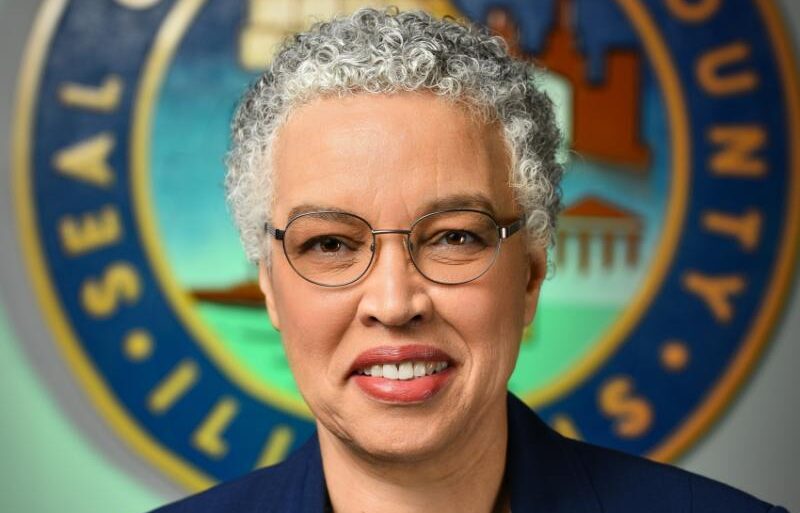

Cook County Board of Commissioners President Toni Preckwinkle and her team of Cook County officials outlined a proposed $9.69 billion budget for fiscal year 2027 during a media roundtable, saying the plan addresses monetary challenges without raising taxes or implementing widespread layoffs.
The proposed budget is a 4.2% decrease from the FY2026 budget and responds to growing pressure from road builders’ litigation, changes in federal health care policies, rising personnel costs, and projected increases in uncompensated care.
Preckwinkle said the County developed a balanced budget despite the challenges that might continue to affect its finances in the coming years.
“The primary message is that we are not raising taxes, and we have developed a balanced budget,” Preckwinkle said. “However, we continue to face several extraordinary challenges that will persist into the coming years.”
One of the most important concerns is a legal dispute over how the County uses transportation-related tax revenue. The County has been restricted from using approximately $250 million annually for certain public safety expenses while the litigation proceeds.
Federal health care policy changes are also expected to affect residents’ insurance coverage and create additional financial demands on Cook County Health, the region’s safety-net health care provider.
Road Builders’ Litigation Creates Budget Challenges
The ongoing litigation has created a substantial challenge for the County’s General Fund. County officials said a Circuit Court ruling restricted the use of transportation-related taxes to pay certain public safety expenses. The County disagrees with the ruling and has appealed.
Laura Lechowicz-Feliciano, the County’s general counsel, explained that the County holds the disputed revenue in a special-purpose transportation fund.
“The Circuit Court determined the way we were expending those dollars wasn’t in accordance with the Illinois Constitution,” she said. “We respectfully disagree, but we have agreed with the judge that we will not use them for that purpose until the courts completely resolve it.”
The restricted revenue totals approximately $250 million to $256 million annually. Officials said the money remains in the special-purpose fund while the legal process continues, creating a funding gap for public safety operations previously supported by those dollars.
The County is seeking a resolution through the appellate process and hopes the outcome will allow officials to plan more effectively for future budgets.
Budget Reductions and Financial Management
Kanako Ishida Musselwhite, the County’s budget director, outlined the financial measures used to address the preliminary budget shortfall. In June, the County projected a $336 million General Fund gap, with about $258 million tied to the road builders’ litigation.
Working with County agencies, officials identified $46.3 million in payroll and overtime reductions and about $34.7 million in non-personnel reductions. The savings included vacancy adjustments, improved overtime management, contract reductions, and changes to certain non-mandated programs.
The County also revised its revenue projections, anticipating approximately $35 million more in sales tax revenue and $58 million more from other revenue sources, including fees and property taxes.
Additional one-time measures included using accumulated interest income, the Pension Stabilization Fund, and reserves originally designated for American Rescue Plan Act-supported programs.
The proposed budget includes a $629.9 million pension contribution. Officials also reported that the County’s unassigned fund balance remains above its established minimum threshold.
Despite a 100.8% budget increase since 2017, the County’s General Fund headcount has declined by 478 positions over 11 years. For FY2027, officials proposed a net reduction of about 50.7 full-time equivalent positions, mainly through vacancies and long-term vacancies rather than layoffs.
Health Care Changes Could Increase Uninsured Rates
Cook County Health officials warned that changes coming on January 1, 2027, to federal health care funding and eligibility requirements are already affecting coverage and are expected to create additional financial pressure in 2027.
Scott Spencer, Cook County Health’s interim chief financial officer, said the effects are already here in Chicago.
“The impact of federal health care funding and eligibility changes is no longer a future concern; it is already being felt,” Spencer said. “Changes to tax subsidies at the beginning of this year have contributed to an increase in the number of uninsured individuals.”
Officials said the expiration of enhanced Affordable Care Act tax subsidies affected an estimated 92,000 Illinois residents statewide. They also cited estimates that 8,500 to 10,000 people will be affected by Medicaid eligibility changes involving certain immigrant populations, including qualifying asylum seekers and victims of domestic violence and human trafficking.
Additional federal Medicaid requirements, including more frequent eligibility redeterminations and work requirements, could put an estimated 330,000 to 400,000 Illinois residents at risk of losing coverage as the changes are implemented. Officials estimated that half of the affected population could be in Cook County.
For Cook County Health, the projected financial impact includes a $138 million decrease in patient service revenue and a $100 million increase in charity care costs.
These changes could leave more residents uninsured while increasing demand for care at a health system that serves patients regardless of their ability to pay.
Cook County Health Focuses on Savings and Access
Cook County Health’s FY2027 budget centers on four priorities: continued cost reductions, operational improvements, protecting access to care, and sustaining a reliable workforce while lessening reliance on contracted labor.
Spencer said the health system has achieved approximately $315 million in savings through operational improvements and cost-control efforts, with additional savings expected through FY2027.
“More margin, more mission,” Spencer said during the discussion, describing how greater efficiency can help the system direct resources toward services that remain underfunded.
The health system is also working to improve revenue management, patient access, and clinical operations while strengthening reimbursement and collections. Officials said the approach aims to balance the budget, maintain patient care, and prepare for future financial challenges.
To help residents navigate Medicaid changes, Cook County Health has also established a Medicaid Impact Work Group involving health care providers, businesses, technology leaders, academic institutions, community organizations, and philanthropic groups.
The initiative has grown from approximately 60 participating organizations to more than 200, according to officials. Its efforts include community education, coalition building, and improving coordination between providers and the state.
The group developed GetMedicaidFacts.com, a resource that offers frequently asked questions, information on Medicaid redetermination assistance events, and links to state resources for changing personal information. Educational toolkits are available in 14 languages for community organizations to share.
Officials noted that residents should keep their contact information up to date to avoid missing renewal notices and potentially losing coverage for administrative reasons.
As Cook County moves toward FY2027, officials say the budget reflects an effort to preserve annual stability while continuing to deliver necessary services. The plan avoids tax increases and widespread layoffs, relying instead on cost reductions, updated revenue projections, and reserve measures to address budgetary pressures.
The continuing road builders’ litigation and changes to federal health care policy remain in significant uncertainties as the County prepares for the next fiscal year.
For more information, visit https://www.cookcountyil.gov/ and https://getmedicaidfacts.com/