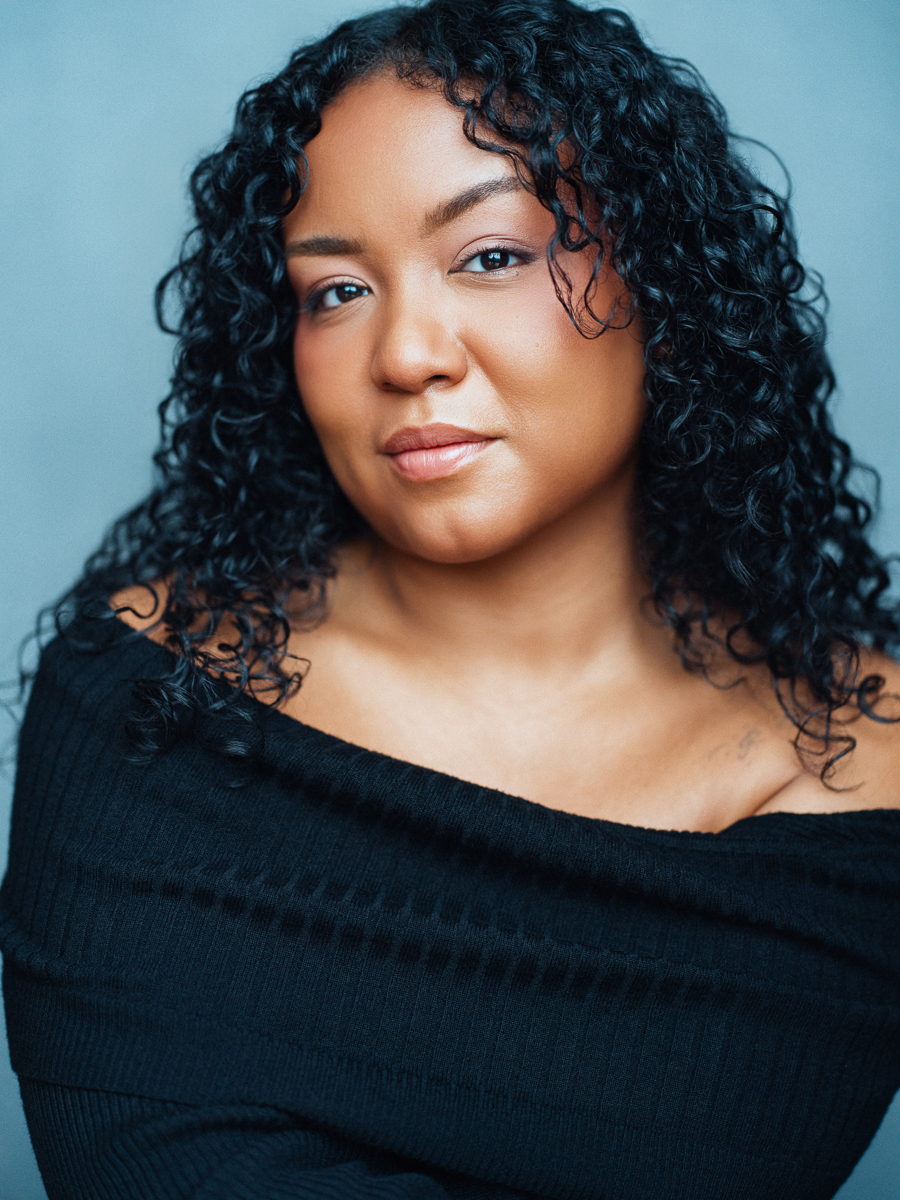

As a Darien native, Copeland discovered her love of theater through her family, childhood musicals, and the arts programs she grew up with. Her journey eventually led her to Northwestern University and Yale, where she continued to develop her craft and joined a strong artistic community of Black artists.
Now, she is touring with Operation Mincemeat: A New Musical, playing stern Colonel Johnny Bevan alongside several other characters. The musical comedy follows a group of British intelligence agents carrying out an unusual World War II deception plan.
Copeland recently spoke with The Chicago Defender about her Chicago roots, discovering theater at an early age, her experience as a Yale student, and her work with FOLKS, an artistic community for Black artists at Yale.
Growing Up Around Chicago Theater
Marshelle Sanders: You’re a Chicagoland native who grew up in the southwest suburbs, specifically Darien. Can you talk about growing up in the area and how that experience eventually led you into theater?
Mariah Copeland: I grew up seeing a lot of musicals when I was younger that my grandmother and my parents would take me to, either here in the city or sometimes up to the theater in Detroit when we visited my grandmother in Ann Arbor.
I was homeschooled until middle school, so I had a lot of free time. Singing and watching old tapes of musicals and musical movies were a big part of how I entertained myself. When I started school, theater was the only activity I could think of. I thought, “That’s my thing.”
I was really lucky that my school system had a fantastic arts program and teachers who gave me a strong music and theater education. That contributed a lot to my career.
The education I received at Downers Grove South, along with my middle school music education, was fantastic. I had teachers who were generous with their time and helped me develop my skills and get to other places.
I felt the same way about Northwestern University. I loved being able to do student-produced and student-run theater there. That’s where I met many of the artists, I still collaborate and work with today, including my husband, Alex.
During my first few years working in the city, I lived in Rogers Park and later moved to Lakeview. Chicago’s storefront theater scene is fantastic.
I always tell people that Chicago is a great place to create and experience something unique because everyone here is so receptive.
The Musical That Stayed with Her
M.S.: You mentioned musicals from your childhood. What musical did you really love growing up?
M.C.: Growing up, a musical I really loved—and one that my mom really loved was Rodgers and Hammerstein’s “Cinderella”. I first saw Brandy do it in the movie.
I really loved it because my parents- my dad is Black and my mom is Filipino- are just like the characters of Cinderella and the prince in the 1997 film adaptation.
It also made me think about representation. In Operation Mincemeat, we all play characters that are very unlike who we are in real life. Theater can sometimes be restrictive in how it sees casting, or in the kinds of stories people assume you want to hear from certain people.
There weren’t any Black Disney princesses or anything like that when I was younger. That hasn’t happened yet. So, it was something that really stuck to me. It’s a really beautiful musical movie.
My mom knew all the music and would sing it with me. It’s one of those things that holds a lot of specific memories for me, and I learned about musicals from my family.
I walked down the aisle at my wedding this summer to a song from Cinderella that plays when she comes into the ball because it holds a lot of memories for me.
M.S.: Did you cry when you walked down the aisle to it?
M.C.: It really felt very magical. In some of my wedding photos, I look a little funny because I’m laughing and grinning so much. I look overjoyed.
It made my mom cry a little bit, so it was really sweet. It was really cool.
Building Community at Yale
M.S.: At Yale, you were a co-director and producer for FOLKS, a drama group for Black students that Angela Bassett originally founded. What was that experience like?
M.C.: I really loved working on FOLKS. We had a group of producers and directors of the organization. It’s a sort of artistic community for Black artists at Yale.
A lot of really fantastic, prolific playwrights, actors, writers, and directors come from that program. There are folks like Angela Bassett and August Wilson, and people who still teach us, Alvin McCraney (Playwright) who I met at Northwestern and then also continued to learn from Yale.
The group does traditional things every year, like a cookout at the beginning and end of the year for everybody to meet each other, say goodbye, and things like that. But we also added time for us to get together, like game nights.
During Black History Month, we did a festival of plays that were just readings of plays by Black playwrights that came from Yale.
That community is really strong. Yale is a predominantly white institution, but it has a rich Black artistic history, and the legacy of the Black artists who have come through that program is incredible.
It’s great to bond with people that way and talk about our work together. We came from so many different places. There were folks from different places in the country, but we also had a lot of folks from outside the country who brought their own Black cultures into our community.
Angela Bassett started a really beautiful legacy. I still follow the group and see what they do, and they still do these really fantastic events and meaningful things to keep that student life alive and keep that community really strong, even when everybody leaves.
It’s one of the things I’m most proud of about going to Yale.
M.S.: Did you ever get a chance to meet Angela Bassett while you were involved with the group?
M.C.: You know, I did not, and it is on my list because she is our Black theater royalty. I would be honored if I could.
Taking on Colonel Johnny Bevan in Operation Mincemeat
M.S.: Tell us about your role in Operation Mincemeat and how you’re enjoying being involved with the show.
M.C.: I play Colonel Johnny Bevan, part of a group of MI5 agents pulling off this very unique plan.
He’s very no-nonsense, very strict, and very much about the rules. He goes head-to-head with another character, Monty, who’s a little more ambitious, silly, and spontaneous than he is.
I really love playing Bevan. He’s such a funny character, and I really love being dry and using dry humor.
It’s a really unique role I’ve gotten to play because a lot of women play men in the show.
We’re all doing really cool things with our body language and voices that aren’t traditionally asked of women onstage. Being able to stand in these positions of power and roles of power with bodies that we don’t always see doing that in stories.
I love doing the show. There are a lot of things you have to get right in terms of timing and teamwork to make sure everything goes the way you want it to for the audience.
Staying Present Through a Transformative Year
M.S.: What motivational statement do you live by, and what’s coming up next after Operation Mincemeat?
M.C.: That’s a cool question.
An affirmation I’m living by right now is about being present. We’re doing the tour for a year, and we’ll see what happens after that year.
I plan to keep doing theater work and TV work and continue to write and perform plays of my own that I’m working on.
But I’ve really been trying to be present. We talk about this thing in the show when we’re working on it: If you think about anything before or anything after, you miss the thing that’s happening right then.
The only way to do a good job and be present is to stay in the moment.
Being a part of this tour, being newly married, and being in my first couple of years out of grad school. I feel really blessed to have so many opportunities.
To learn more about Mariah Copeland, follow her on Instagram at @MariahLCopeland and visit mariahcopeland.com.
For more information on Operation Mincemeat: A New Musical, visit Broadway in Chicago.
The production runs September 29–October 11, 2026, at the CIBC Theatre, 18 W. Monroe St., Chicago.