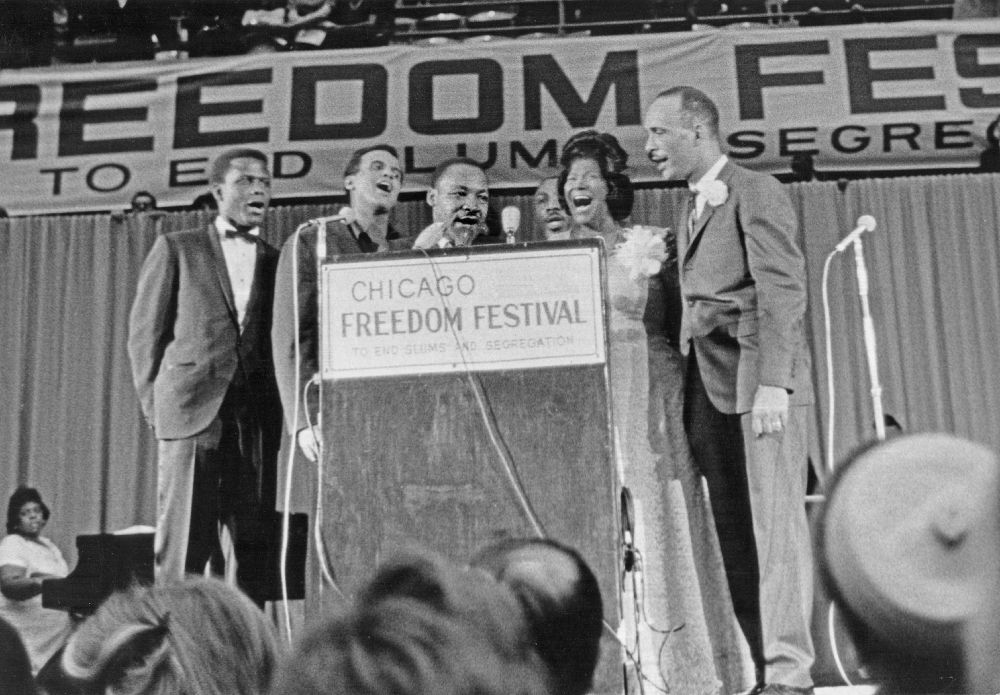

As we celebrate Dr. Martin Luther King Jr.’s birthday, Martin Luther King Jr. Day, observed Monday, January 19, 2026, offers a time to remember his life, his leadership, and the unfinished struggle for justice.
Many people remember Dr. King’s leadership in the South. However, his time in Chicago was among the most challenging and eye-opening of his civil rights work. There, he faced segregation upheld by customs, economic barriers, and violence instead of laws.
Why Dr. King Came to Chicago
In late 1965, Dr. King brought his crusade for civil rights to Chicago at the invitation of the Chicago Freedom Movement, a coalition of 44 civil rights organizations. They aimed to end poor housing conditions and discrimination that kept Black residents in crowded, underfunded neighborhoods. While King had visited Chicago before to support the fight for Black freedom, this campaign was his most personal and dedicated effort in the city.
Dr. King, James Bevel, and Al Raby led the Chicago Freedom Movement to fight racial segregation in Chicago and its suburbs. The movement wanted to end slums and push for real change. Activists formed tenants’ unions, held rent strikes, took over slum buildings, and brought people from different backgrounds together. They also started Operation Breadbasket, which used community buying power to encourage businesses to hire Black workers.
Living the Struggle in North Lawndale
In January 1966, deepening his commitment, Dr. King and his family moved into a rundown apartment at 1550 South Hamlin Avenue in North Lawndale on Chicago’s West Side. He lived there for six months to see for himself the tough conditions many Black Chicagoans faced. By doing this, he showed that segregation in the North was real and harmful.
Marching for Open Housing in Marquette Park
The most dramatic moment of King’s Chicago campaign—marching for open housing—occurred on August 5, 1966, when he led a protest into all-white neighborhoods near Marquette Park. Protesters faced angry crowds who threw bottles, rocks, and bricks. Dr. King was hit in the head and knocked down, but he got up and kept marching.
The violence shocked people across the country. King later said he had never seen hatred as strong as what he faced in Chicago, powerfully illustrating that racism was a nationwide problem, not only a Southern issue.
The Summit Agreement and Its Limits
After the Marquette Park protest, Dr. King, Mayor Richard J. Daley, and other leaders reached the Summit Agreement in August 1966. King called it “the most significant program ever conceived to make open housing a reality in a metropolitan area.” Although it was a step forward, the agreement was not rigorously enforced, and segregation in Chicago largely persisted.
Even though the Chicago campaign did not bring big changes right away, it left a major mark on the nation. The movement spotlighted housing discrimination as a national issue and helped lead to the Fair Housing Act of 1968, which became law on April 11, 1968 with President Lyndon B. Johnson, just one week after Dr. King was killed.
“I’ve been to the mountaintop. I may not get there with you. But I want you to know tonight, that we, as a people, will get to the Promised Land.” – Dr. Martin Luther King Jr.
Chicago After Dr. King
Dr. King left Chicago in 1967. After he was killed on April 4, 1968, grief and anger led to unrest on Chicago’s West Side, showing the deep problems his work tried to fix.
Remembering King Through Place and Purpose
In honor of Dr. King’s work, community groups established the Martin Luther King Jr. Living Memorial at Marquette Park. The memorial’s brick and limestone steles, tiled bench, and multilingual inscriptions reflect the meaning of “home,” and the beloved community King envisioned, one where all people have dignity, opportunity, and a secure place to live.
Martin Luther King Jr. Day: Carrying the Legacy Forward
President Ronald Reagan signed the law creating Martin Luther King Jr. Day on November 2, 1983. The first national holiday was observed on January 20, 1986.
By 2000, every state officially recognized the holiday. Today, the day honors both Dr. King’s birthday and his lasting call to action. Remember Dr. King on this day; his time in Chicago reminds us that the struggle for justice often unfolds closest to home and that meaningful change requires courage, persistence, and collective responsibility.
On Monday, January 19, 2026
Explore these events honoring the life, legacy, and vision of Dr. Martin Luther King Jr.
Chicago History Museum
Commemorative Day | Martin Luther King Jr. Day
This family-focused celebration highlights Dr. King’s enduring influence on the fight for civil rights. Visitors can enjoy hands-on activities and learn meaningful ways to become more civically engaged within their communities.
Griffin Museum of Science and Industry
Black Creativity Juried Art Exhibition
The nation’s longest continually running exhibition of African American art, displayed annually since 1970. Black Creativity features paintings, drawings, fine art prints, sculpture, mixed media, ceramics, and photography by Black artists including youth artists ages 14 to 17.
Hyde Park Art Center
MLK Day 2026: Chaos or Community
A dynamic, all-ages program blending live music, film, artmaking, and meditation. This event explores art as a vessel for collective memory, liberation, and joy while reflecting on Dr. King’s lasting impact on social justice and culture. Registration is recommended.
Chicago Sinfonietta
MLK Tribute Concert
This year’s tribute honors Dr. Daniel Hale Williams, the pioneering Black Chicago surgeon who performed the first successful open-heart surgery in 1893 and founded the nation’s first Black-owned hospital. The concert reflects on how opening hearts, both medically and socially, remains a powerful legacy aligned with Dr. King’s vision.